
Laparoscopic cholecystectomy
(Removal Of Gallbladder)
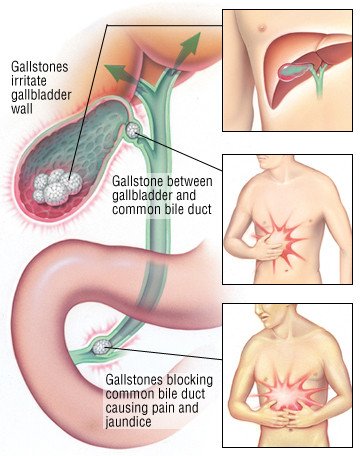
Indication:
Gallstones: Gallstones are common and often cause no problems. However, in some people they can cause:
- Pain – This arises if gallstones block the outlet of the gallbladder. It can last minutes to hours and resolve spontaneously (biliary colic). It may however last longer, with inflammation of the gallbladder (cholecystitis), often requiring antibiotics. The pain is usually in the right upper part of the abdomen radiating to the back.
- Pancreatitis – Inflammation of the pancreas can occur if a stone passes down the bile duct and irritates the opening to the pancreas.
- Jaundice – This is a condition whereby a patient turns a shade of yellow, often most noticeable in the white of the eyes. It is due to a stone moving from the gallbladder into the bile duct, and partially blocking the flow of bile into the bowel. If this occurs, your urine may become darker, your feces lighter, and your skin may itch.
Procedure:
Both the gallbladder and stones are removed. This can be done as a laparoscopic (keyhole surgery) procedure. The incisions involve making four small holes in the abdomen, each 1-2cm in length. Occasionally it is not possible to complete the operation laparoscopically and a larger incision (cut) may be needed under the right rib margin. The risk of the keyhole operation being converted to an open operation is about 2%.
Possible complications:
The operation is usually straightforward with 95% of people having no long-term side effects following the surgery. However, the following complications may occur:
- Shoulder pain – This often happens after keyhole surgery but tends to last less than 24 hours. It is due to the gas used to inflate the inside of the abdomen during the operation.
- Infection – This can occur in the wound(s), in the lungs, at the site of the intravenous drip, or at the position where the gallbladder was located.
- Bleeding – This can occur during or after the operation, as with any surgery.
- Damage to surrounding structures – Rarely, nearby structures can be inadvertently damaged during the operation. These structures include the bile duct, bowel, and blood supply to the liver. A bile duct injury is potentially very serious but rare, occurring in approximately 3 in every 1000 operations. An injury to the bile ducts can lead to a bile leak, which would likely necessitate a further procedure to drain the leak and in severe cases may require another operation to repair the bile ducts.
- Deep vein thrombosis (DVT)/Pulmonary embolus (PE) – Clots forming in the veins can occur with any surgery, but the risk is increased with laparoscopic surgery. We give you a blood-thinning agent to decrease this risk and ask you to wear compression stockings for two weeks following the operation.
- Retained stone – Before or during the operation a stone can move into the main bile duct. This often causes no problem and passes into the bowel. However, if it does not pass, a second endoscopic procedure may be necessary to remove it.
Duration:
Approximately 90 minutes depending on the intra-operative findings.